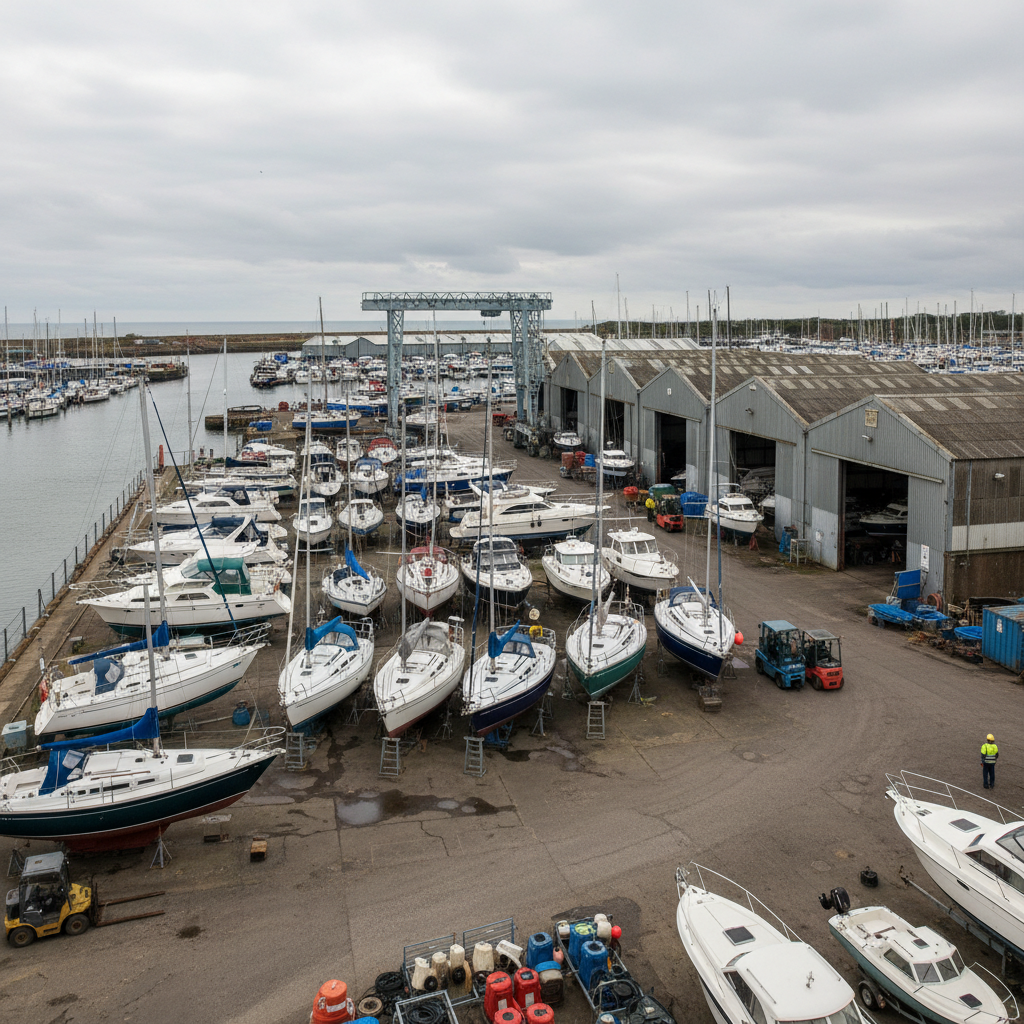
For UK boatyard operators, managing a busy workshop involves more than just keeping track of nuts, bolts, and antifoul. From COSHH regulations to VAT accountability and environmental standards, your stockroom is a focal point for regulatory compliance. Without a rigorous approach to boat yard inventory management, your facility risks not only financial leakage but also potential legal liabilities that could affect your standing with local authorities and insurers.
The complexity of the modern marine industry requires a shift from old-school tally sheets to digital systems. Whether you are handling hazardous resins for a refit or high-value electronics for a luxury yacht, maintaining a transparent and traceable inventory is essential. This guide explores how to align your stock control with UK compliance requirements while boosting your workshop's overall efficiency.
COSHH and Hazardous Material Tracking
In a UK boatyard, hazardous substances are part of daily life. From thinners and epoxies to specialised marine paints, the Control of Substances Hazardous to Health (COSHH) regulations mandate that you know exactly what is on-site, where it is stored, and how it is being used. Effective boat yard inventory management allows you to link Safety Data Sheets (SDS) directly to your digital stock records, ensuring your team has immediate access to safety information.
Crucially, automated inventory systems can help track expiry dates for chemical products. Using expired resins or shelf-life-limited adhesives isn't just a quality issue; it's a safety and compliance risk. By setting up automated alerts, you can ensure that only compliant, safe materials are used on customer vessels, which is vital for maintaining your professional standards and insurance coverage.
Financial Traceability and HMRC Compliance
VAT treatment in the marine sector can be notoriously complex, particularly when dealing with zero-rated parts for commercial vessels or qualifying ships. Robust boat yard inventory management provides a digital trail that links every part purchased to a specific job card and eventual invoice. This level of detail is indispensable during an HMRC audit, as it demonstrates that VAT was applied correctly based on the material usage.
Integrating your stock control with a larger [Marine Business Management Guide](/blog/marine-business-management-guide) framework ensures that your financial reporting is accurate. When you can prove exactly where a specific high-value engine component went, including the boat name, the date of installation, and the technician responsible, you mitigate the risk of financial discrepancies and phantom stock loss.
20% Efficiency Gain
UK yards transitioning to digital inventory management often see a 20% reduction in wasted technician time searching for parts.
Waste Management and Environmental Accountability
With the UK's increasing focus on environmental protection, particularly in coastal and inland waterway areas, boatyards face strict scrutiny regarding waste disposal. Effective inventory management plays a role here by helping you track the 'cradle-to-grave' path of consumable items. For example, knowing the volume of solvent cleaners purchased versus the volume of waste collected can help you prove you are following sustainable disposal practices.
Digital tools available at [marinayardmanager.co.uk](https://marinayardmanager.co.uk) allow managers to monitor usage patterns. If a project is using significantly more paint or chemical stripper than estimated, it may indicate a spill or improper handling—events that need to be captured for both environmental compliance and cost recovery. Maintaining a lean, well-documented inventory reduces the likelihood of stockpiling hazardous old liquids that eventually become expensive and risky to dispose of.
Features
Related Articles
Audit Trails and Insurance Requirements
In the event of a fire, theft, or liability claim, your insurers will require detailed records of your current stock levels and their valuation. Relying on an annual physical stock-take is often insufficient for insurance compliance. Modern boat yard inventory management systems provide a real-time 'valuation of stock on hand,' giving you an accurate figure at the touch of a button.
Moreover, if a manufacturer issues a recall on a specific part—such as a faulty sea cock or an electrical isolator—a digital inventory allows you to search your history instantly. You can identify which boats that specific batch was installed on, allowing you to proactively contact customers for remediations. This proactive safety management is a hallmark of a high-compliance yard and builds significant trust with your clientele.
The Role of Technology in Compliance
Transitioning to a digital platform like Marina Yard Manager simplifies the burden of compliance. Instead of filing cabinets full of delivery notes, you have a searchable database. Technicians can use mobile devices to scan parts out of the stores directly onto a job, ensuring that the inventory reflects the real-world state of the yard in real-time.
Automation also reduces human error, which is the primary cause of compliance failures. When the system automatically alerts you when stock of a critical safety item—like fire extinguishers for hire boats or lifejacket canisters—is running low, it ensures you never fall below the legal requirements for your operations. By centralising these functions, you free up your workshop manager to focus on quality craftmanship rather than paperwork.
Frequently Asked Questions
How does inventory management help with COSHH compliance?
It allows you to maintain an accurate register of all hazardous substances, store their Safety Data Sheets digitally, and track expiry dates to ensure only safe, compliant materials are used.
Can inventory software help with UK VAT audits?
Yes, it creates a clear audit trail linking every purchased part to a specific customer invoice, ensuring you have evidence for zero-rating or standard-rating decisions.
What is the best way to handle marine parts recalls?
Using a digital inventory system to record batch numbers and installation dates allows you to instantly identify which vessels received the recalled parts.
Related Reading

Written by
Hamish Lowry-Martin
Founder & Lead Developer
With 30 years in IT and 20 years developing business systems, Hamish spent the last decade working closely with marinas and boat yards — watching first-hand how they struggle with outdated tools. That hands-on observation led to Marina Yard Manager.
Learn more about our teamReady to Streamline Your Yard?
Start your 14-day free trial. No credit card required.
Start Free Trial